
What are the benefits of using HR software? Many business owners and HR managers in Bangladesh start asking this when daily HR work feels heavier than it should. Attendance sheets don’t match payroll records. Leave requests sit in email threads, paper forms, and phone messages. Employee files are spread across folders that only one or two people know how to find.
This doesn’t happen because people aren’t trying. It usually happens because the tools haven’t kept up with team growth.
That’s why more companies are looking at HR Software in Bangladesh as a practical, realistic way to manage employees across growing teams. A digital HR system brings records, attendance, leave, and payroll closer together instead of keeping them in separate places. The point isn’t to replace HR teams. It’s to give them clearer structure, fewer repetitive tasks, and better access to the information they use every day.
What Are the Benefits of Using HR Software in Practice?
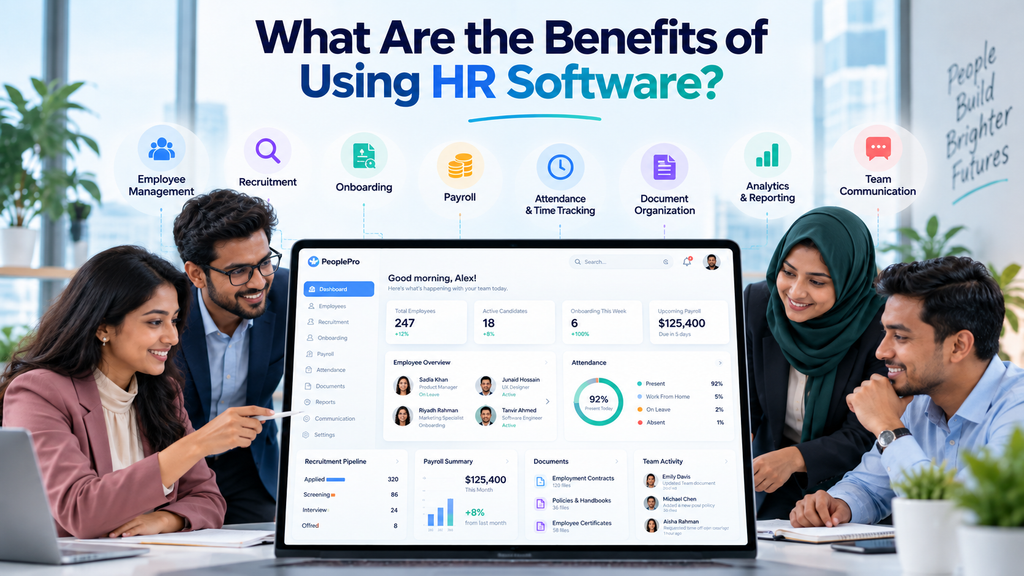
The answer depends on the company. A small trading business, a busy garment factory, and a service firm with several branches won’t use HR software in the same way. Still, the practical benefits usually fall into a few familiar areas:
- Employee information kept in one organized place
- Attendance and leave records that are easier to maintain
- A more structured payroll process
- Employees who can check basic information themselves
- Reports that take less effort to prepare
None of these happen just by installing a system. They depend on good setup, clean data, and teams that actually use the tools. When those pieces are in place, the difference in daily work can be easy to see.
From Manual HR Work to Digital Employee Management
For a long time, employee management in many Bangladeshi companies has run on a mix of methods. Employee details go in a spreadsheet. Attendance comes from a register or a standalone fingerprint machine. Leave is approved on paper. At the end of the month, someone gathers it all and prepares payroll.
Each method works well enough on its own. Problems tend to show up where they meet.
The same information gets typed more than once. One file says an employee was absent while another doesn’t. Old records take a long time to find. Employees aren’t sure how much leave they have left, and managers aren’t sure either. Payroll week turns into a rush of cross-checking.
Manual work isn’t wrong. It just gets harder to keep accurate as more people join.
Centralizing Employee Information
One of the most useful changes is a single employee database. Joining dates, job titles, departments, contact details, documents, attendance history, and leave records can all live in one structured place.
That sounds basic. In practice, it changes a lot.
HR teams don’t have to search through several files to answer a simple question. When an employee’s details change, they update them once. This idea sits at the heart of HRIS Software in Bangladesh. HRIS stands for Human Resource Information System, meaning a system built to store and manage employee information in an orderly way.
Access can also be controlled. Sensitive details like salary or personal documents can be limited to the people who actually need them.
Better Attendance and Leave Management
Attendance is often the first place a company feels the difference. Most digital systems pull check-in and check-out times straight from a fingerprint machine, card reader, or mobile app. The HR team doesn’t have to collect them by hand. The system then sorts the records by employee, date, and shift.
That’s useful on a normal Tuesday morning. If a supervisor wants to know who came in late last week or how much overtime a team worked, the answer is already there. Nobody has to dig through a register or copy figures from one sheet to another.
Leave works much the same way. An employee sends a request through the system, and it goes to the right manager for approval. If the company needs more than one person to sign off, the request moves through each of them in order. Once it’s approved, the leave balance changes automatically.
Employees can check their remaining days without asking HR. Managers can see who’s already off before they approve another request, which matters a lot during busy periods like Eid or month-end.
More Organized Payroll Processing
Payroll is usually the most time-sensitive part of HR. Basic salary, allowances, overtime, deductions, bonuses, and attendance adjustments all need to come together on schedule.
Payroll Software in Bangladesh can bring order to that process. Salary structures are set up once. Allowances and deductions follow defined rules. Attendance and leave data feed directly into salary calculations, without being retyped.
That link is where much of the value sits. When attendance and payroll live in separate systems, someone has to move data between them by hand, and every manual step adds room for mistakes. Connecting the two can reduce repeated data entry and may make calculation issues easier to spot before salaries go out.
Automated payroll still needs human review. Finance and HR teams should check the output each cycle. They spend less time on repetitive arithmetic.
Employee Self-Service and Clearer Communication
Many HR requests are small. Someone wants a payslip. Someone else wants to check their attendance for last week, or how many casual leave days they have left.
An employee self-service portal lets employees see this information themselves, within the limits the company sets. Many systems also share notices, policies, and holiday calendars through the same platform.
For employees, that means less waiting. For HR teams, it means fewer interruptions and more time for work that needs a real conversation.
HR Reporting and Decision-Making
Once HR data is organized digitally, reports become far easier to prepare. HR teams can pull summaries on attendance patterns, leave usage, payroll costs, headcount by department, and employee turnover.
Reports don’t make decisions. They do give managers a clearer picture, so planning conversations can start from actual records rather than memory or guesswork.
Final Verdict
HR software can’t solve every problem at work, and it won’t replace an experienced HR person’s judgment. What it does well is cut down the mess. Employee records are easier to find. Attendance and leave sit in one place. Payroll runs on clear rules, so fewer numbers get copied by hand.
So, what are the benefits of using HR software? For many companies in Bangladesh, they come down to structure, visibility, and time. Less time chasing information means more time for the people behind the records. That’s a realistic, worthwhile reason to start, with a clear plan and the right questions.