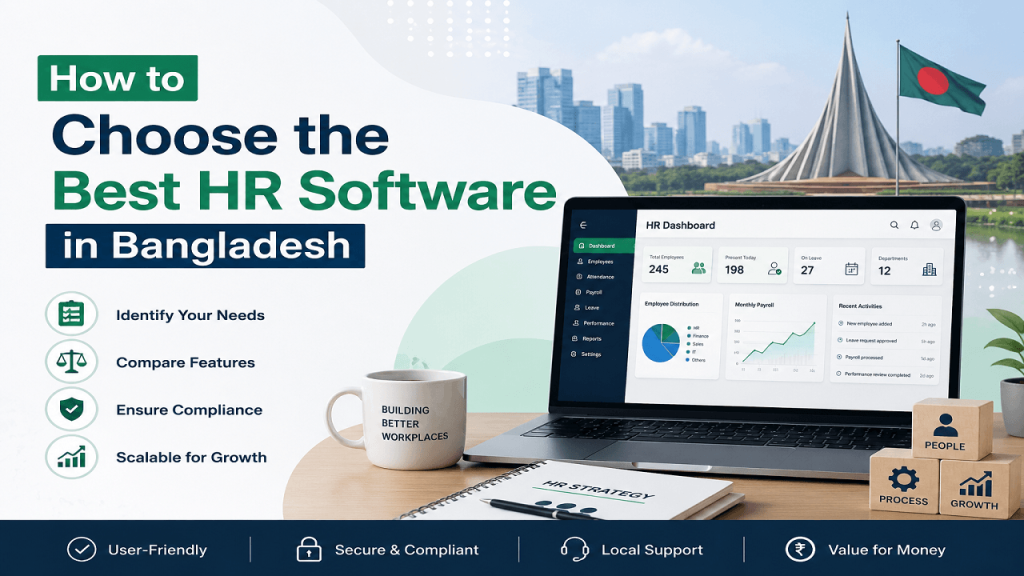

Choosing the right HR Software is one of the most important decisions for any organization that wants to increase efficiency, reduce manual workload, and manage employees in a structured way. This is even more critical for Bangladesh, as industries such as garments, textiles, manufacturing, healthcare, and NGOs employ large, complex workforces.
A modern HR system isn’t just a digital storehouse for employee data anymore. It is the backbone for payroll accuracy, attendance control, workforce planning, and compliance management. That’s why businesses are now turning towards advanced HRIS Software, HRM Software, and Payroll Software solutions to streamline operations and remove manual errors.
However, the biggest confusion most companies face is not whether they need HR software, but how to pick the right one. There are many options on the market, but not all of them are appropriate for real business needs. A structured and practical approach that focuses on real HR challenges, not just software features, is required to make the right decision.
How to Choose the Best HR Software
It’s easy to choose the right HR software when you look at actual needs in the workplace, not marketing claims. A good HR system should be adapted to your operations, increase accuracy, and ease the workload of your HR team. Here are the main things to think about before you decide.
Start by identifying your real HR challenges
All organizations face different HR issues, and understanding them is the foundation for selecting the right software. Some businesses struggle with attendance tracking errors, others with payroll calculation or employee record management across departments.
The large size of the workforce, multiple shifts, and the management of overtime further escalate the HR complexities in sectors such as garments and manufacturing in Bangladesh. For hospitals, it is another hurdle, the 24-hour staff rotations, and for NGOs, it is the field staff in remote areas.
If you don’t understand these internal challenges well, you may end up choosing a system that looks good but doesn’t solve your real problems. Good HR software isn’t built around feature-sets; it’s built around the pain that your HR team faces every day.
Make sure the software fits your workflow, not the opposite
One of the biggest mistakes companies make is to adapt their internal workflow to the software. This frequently results in long-term operational difficulties and reduced efficiency. The best HR Software in Bangladesh should instead fit into your existing HR structure.
For example, if your organization uses shift attendance, the system should be able to handle multiple shift setups. If your payroll system has overtime, allowances, and deductions, the software should calculate everything automatically without any manual intervention. If your organization has more than one department or location, there should be simple centralized control.
Imposing changes to workflows generally triggers resistance from HR teams and poor adoption.
Real-time data processing improves HR decision-making
One of the most important features of the modern HRIS Software in Bangladesh is real-time data. Traditional HR systems often process data at the end of the day or month, which leads to delays and increased potential for error.
Attendance updates in real time, payroll updates automatically, and HR dashboards display real-time employee information. It helps managers make faster and more accurate decisions without waiting for manual reports.
In fast-moving sectors like garments, textiles, and healthcare in Bangladesh, real-time HR data is not a luxury but a necessity for operational control and efficiency.
Payroll accuracy is critical for employee trust
Payroll is one of the most sensitive areas of HR management. A little mistake in the calculation of salary can lead to dissatisfaction of employees and loss of faith in the organization. That is why choosing a reliable Payroll Software is very important.
A good system should be able to auto-calculate salaries based on attendance, overtime, leave records, and deductions. It’s got to minimize human intervention; it’s got to be month-to-month consistent.” Payroll automation and accuracy allow HR teams to spend less time fixing errors and more time on strategic tasks.
Payroll Accuracy Isn’t Just a Technical Requirement – It’s a Core Component of Employee Satisfaction and Organizational Stability.
Ease of use determines long-term success
No matter how good the HR system is, it will fail if it’s too difficult to use day in and day out. Many organizations invest in advanced software but don’t implement it properly as HR teams struggle with usability.
HRM Software should have a simple and easy-to-use interface that HR staff can use to record attendance, payroll, and employee records without having to undergo technical training. Easy to use = faster adoption, less training time, smoother day-to-day operations.
Ease of use is directly related to how effectively the software can be applied in real-life scenarios.
Industry compatibility ensures real-world performance
Not all HR software is made for every industry. This is a key element many businesses neglect when choosing. What works well for a corporate office may not be suitable for a garment factory or a hospital setting.
garment Industries require shift-based attendance and large-scale overtime monitoring. Hospitals must plan duty and emergency shifts on a 24/7 basis. NGOs need flexibility to track workforces in multiple field locations. In manufacturing industries, attendance and labor tracking related to production are required.
This is why the best HR system should cater to various industries such as garments, textiles, spinning mills, food production, plastic, ceramics, steel industries, hospitals, NGOs, and corporate organizations.
Security and data protection must be a priority
HR systems contain very sensitive information, such as salaries, personal records, and attendance history of employees. Therefore, security is a must-have feature of HR software.
The system should have secure data storage, role-based access control, and encrypted communication channels. It should also have backup systems to prevent data loss. Without robust security, even the most sophisticated HR system is a gamble for long-term organizational use.
Trust and data security are the building blocks of HR integrity.
What happens if you ignore proper HR software considerations
Problems typically arise when a business selects HR Software without first assessing its needs. But real problems appear when the system does not fit actual HR workflows. Everything might look fine at first sight. This does not solve problems but creates confusion in the daily operations.
Workflow mismatch is a critical issue. If the software does not perfectly support your attendance system, shift structure, or payroll rules, HR teams are left to manually correct outside of the system. This increases the workload and reduces efficiency.
Another frequent issue is payroll errors. If HRIS Software doesn’t match business rules, then salary calculations are inconsistent, and over time, this impacts employee trust and satisfaction.
Often, companies also see low adoption because the system seems too complicated or does not fit the reality of how people work. This leads to parallel manual work, which is counterproductive to the use of HR software.
That is why it is important to select HRM Software or Payroll Software properly for accuracy and smooth functioning of HR for a longer period of time.
Where Jibika Plexus fits into this decision
With all this in mind, it is easier to understand what a complete HR solution should be delivering. A platform like Jibika Plexus is built to solve these very issues of modern-day business in Bangladesh.
The focus is on simplifying HR operations by using AI-based attendance systems, real-time HR data processing, and automated payroll management. It streamlines HR workflows, making processes faster, more accurate, and easier to manage across industries such as garments, manufacturing, healthcare, NGOs, and corporate organizations, rather than complicating them.
Final Thoughts
Selecting the right HR Software does not mean getting the most popular system; it is about getting the system that suits your business needs and makes your HR operations easier. When you compare software to real challenges, the decision makes a lot more sense and is much more powerful, given compatibility with workflows, real-time processing, payroll accuracy, usability, industry fit, and security.
A robust HR system not only handles your employees but also improves the entire structure of your organization’s operation.