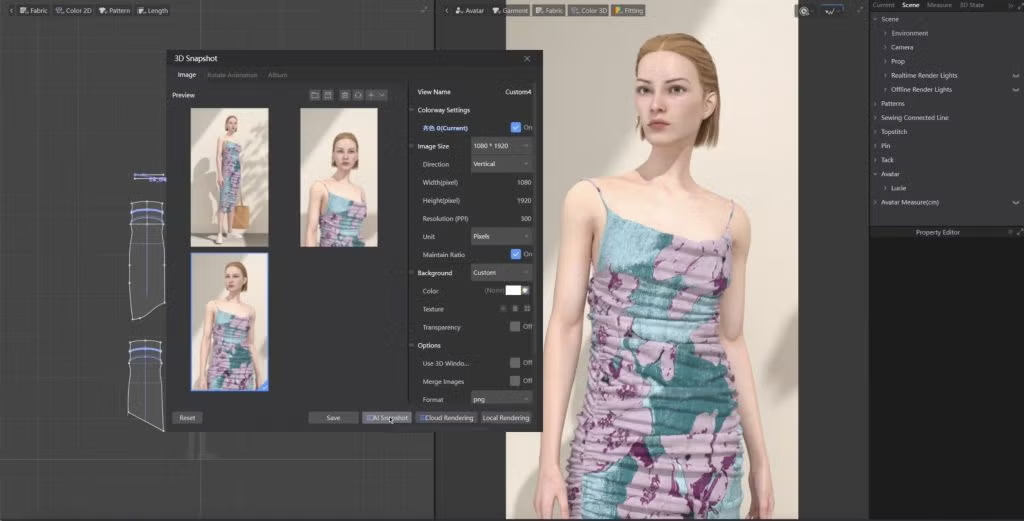

The barrier to entry in the fashion industry has never been lower, thanks to a wealth of digital tools that empower creativity and technical development. Aspiring designers and small brands now have access to the best free online apps for designing clothes, enabling them to conceptualize, visualize, and even market their creations without significant upfront investment. However, moving from a purely digital concept to a production-ready, accurately sized garment often requires incorporating real-world data, a task increasingly handled by advanced digitization technology, most notably the 3d scanner. The synergy between accessible software and high-fidelity measurement tools defines the modern, democratized fashion workflow.
The Accessibility of the Best Free Online Apps for Designing Clothes
The proliferation of the best free online apps for designing clothes has created a dynamic and accessible entry point into the fashion world. These platforms cater to various skill levels and design needs, from simple graphic creation to complex pattern drafting. They remove financial hurdles, allowing a global community of users to begin their design journey.
1. Graphic and Custom Apparel Tools: Apps like Canva provide robust, free-to-use platforms with extensive template libraries and drag-and-drop features, ideal for creating custom prints, logos, and graphics for apparel like T-shirts and hoodies. Coupled with print-on-demand services like Printify, these tools enable entrepreneurs to launch apparel lines and begin selling without inventory risk.
2. Sketching and Visualization Platforms: For those focused on garment structure, tools like Nastix Design and Repsketch offer browser-based sketching and flat-design capabilities, often assisted by AI for rapid visualization. Another vital category is free-to-use platforms like Tailornova, which offers 3D fit simulation using pattern templates, allowing designers to visualize basic drape and fit on a virtual body.
3. Pattern Drafting and Technical Design: Platforms like Sewist CAD and Seamly2D provide free, professional-level 2D pattern drafting and customization, including parametric design capabilities and industry-standard export formats. These tools are crucial for students and professionals who need to ensure technical accuracy in garment construction before moving to a 3D environment.
These free apps are foundational, but their outputs are primarily digital files—sketches, graphics, or 2D patterns. To ensure a perfect, real-world fit and to accurately digitize materials, a physical bridge is required, leading designers to advanced scanning technology.
The Technical Bridge: Utilizing the 3D Scanner in Modern Fashion
The 3D scanner represents a crucial technical bridge between the physical and digital fashion worlds, primarily used for capturing accurate body data and material properties. The ability of a 3D scanner to precisely map real-world objects is indispensable for high-fidelity garment creation and production.
1. Body Scanning for Perfect Fit: Body 3D scanners are used to capture the exact measurements and posture of a model or consumer. This data is converted into high-fidelity 3D avatars. When designers use these avatars in their software, they can guarantee that the virtual garment’s fit is tailored to a precise, real-world shape. This capability minimizes fit errors, reduces the need for multiple physical fittings, and significantly improves customer satisfaction in virtual try-on scenarios. For brands, choosing the right 3D scanner involves considering factors like scanning speed, accuracy (measured in millimeters), and ease of use, as the quality of the scan directly impacts the garment’s virtual fit.
2. Material Digitization (Fabric Scanning): Specialized fabric 3D scanners, like those used in Style3D’s Fabric suite, are essential for capturing the detailed physical properties of textiles. These devices precisely measure texture, color, and crucial behavioral characteristics such as bending stiffness, weight, and stretch. This data is then translated into a digital twin of the fabric. Without this scientific material data, the advanced 3D simulations created using the best free online apps for designing clothes would lack realism. The fabric scanner ensures that a digital silk garment drapes like silk and a digital denim jacket hangs like denim.
The Integrated Digital Workflow
The journey of a design typically begins with the creative ideation phase using the best free online apps for designing clothes. For instance, a designer might sketch a new dress silhouette using Nastix Design. To ensure the dress fits accurately, they would rely on body scan data captured by a 3D scanner to create a custom avatar. Finally, to guarantee a realistic virtual appearance, they would select a digital fabric twin created by a material 3D scanner.
This integrated approach leads to highly efficient and sustainable product development. By utilizing free tools for creative access and combining their output with the high precision of 3D scanner data, designers can iterate rapidly on accurate virtual prototypes. This minimizes physical sampling, reduces waste, and accelerates the entire product creation cycle, ultimately transforming the accessibility and professional capability of modern fashion design.


